Will a tank that performs perfectly today still be in the same condition two years from now?
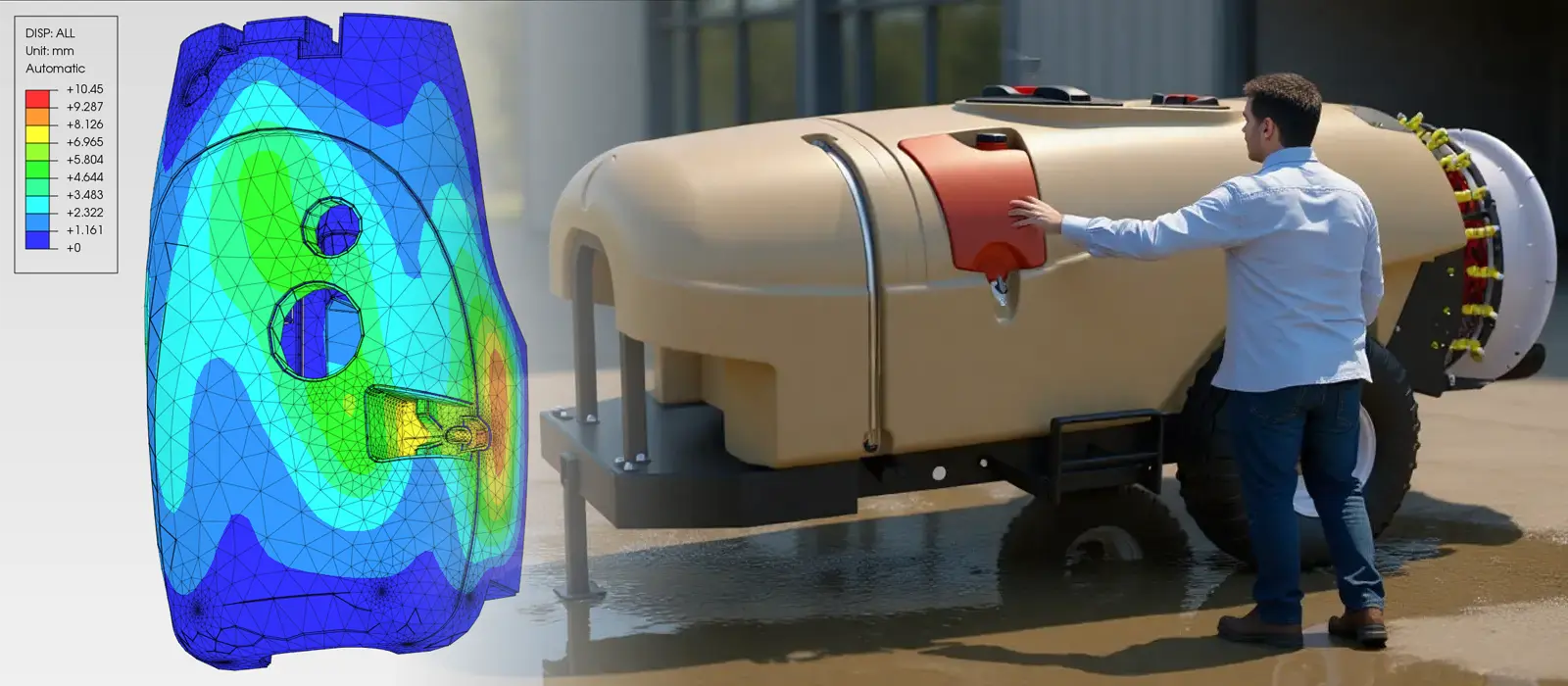
The loads acting on agricultural sprayer tanks change continuously as the vehicle moves. Under field conditions, the tank body and connection areas are repeatedly subjected to loads, while the behavior of the raw material also changes over time due to sunlight and temperature.
By examining real operating conditions in a numerical environment, we identify weak regions and unnecessary material use before production begins.Because solving a problem during the design stage is far less expensive than solving it in the field.
Integrated Analysis of Agricultural Sprayer Tanks
We evaluate the tank not in isolation, but together with the liquid, chassis, supports, fastening elements and operating conditions.
Instead of increasing the overall wall thickness, we identify where the loads actually concentrate and improve the geometry there.
The result is not just a color map; it turns into decisions about ribs, supports, chassis contact, wall thickness and, when needed, internal flow-control elements.
How Do We Analyze?
We begin by defining the tank's actual operating conditions. How much liquid it will carry, how it will sit on the chassis, how vehicle motion will affect it, the temperatures at which it will be used and how long it will be exposed to these conditions are the starting points of the analysis.
We do not evaluate the tank only according to the load it carries on day one. We examine the pressure generated by the liquid, the loads caused by vehicle motion, the chassis and connection areas together with the effects of temperature and long-term use on polyethylene.
- Effect of the liquid:We examine the pressure generated when the tank is full and how the liquid moves inside the tank as the vehicle moves.
- Tank and chassis:We determine how these loads are transferred to the tank body, supports and connection areas, and where they concentrate.
- Time and temperature:Polyethylene may deform more over time under the same load. We evaluate how the tank will behave not only today, but also over long-term use, taking the effect of temperature into account.
- Integrated evaluation:By bringing all results together on the same design, we reveal weak regions, areas that may cause problems over the long term, and regions where unnecessary material is being used.
What Do We Check?
For an agricultural tank, it is not enough to ask only whether it can withstand the load. We check where the tank deforms excessively, where loads concentrate, how the connections and chassis contact behave, and which regions may become problematic after long-term use.
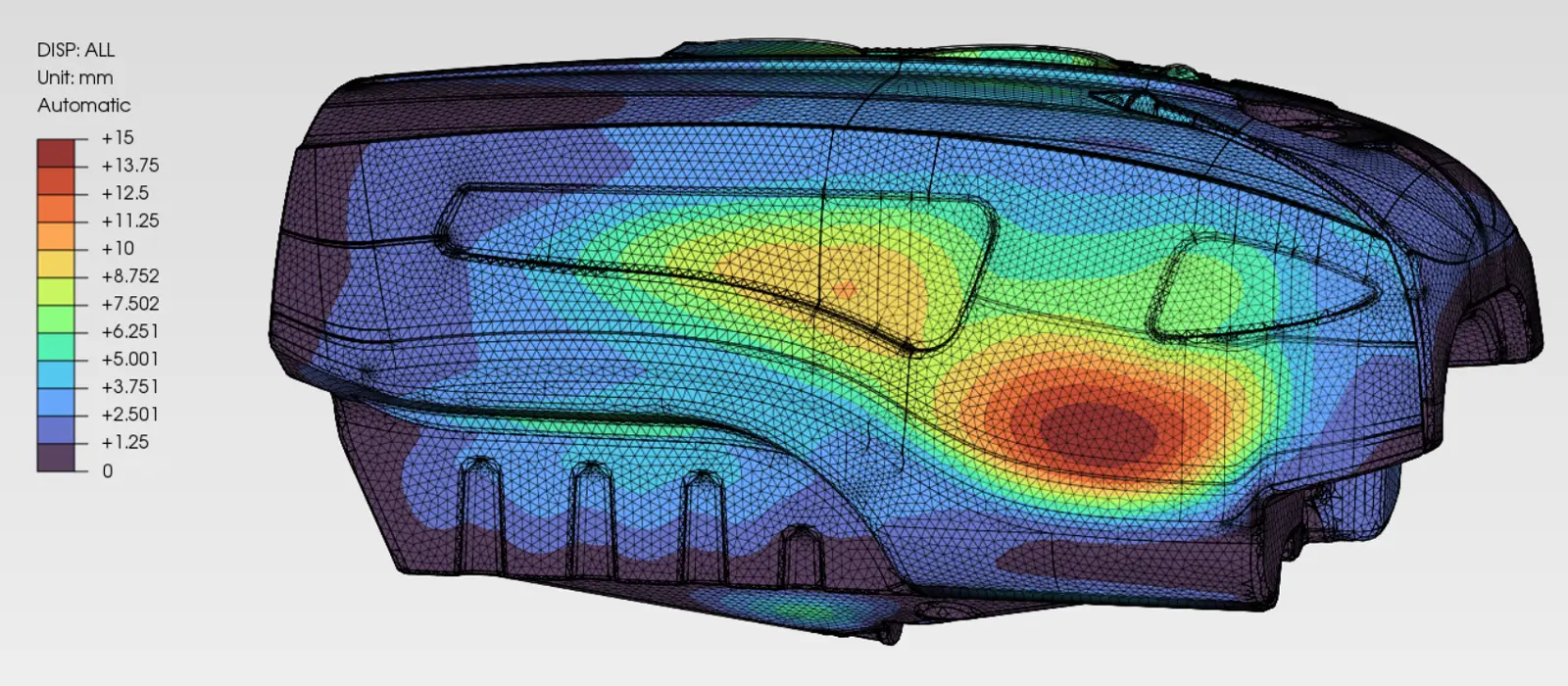
At the end of the analysis, we do not look only at the highest stress or deformation value. We evaluate where these values occur on the tank and what they mean in terms of real operating conditions.
- Tank body and deformation:We check how much the body flexes, bulges or changes shape when the tank is full and the vehicle is moving.
- Supports and chassis contact:We examine whether the load is distributed properly where the tank rests on the chassis and whether excessive local loading occurs at specific points.
- Connections and critical regions:We check whether loads concentrate around fastening points, openings and manholes, rib roots and abrupt geometric transitions.
- Long-term behavior:We evaluate whether regions that show no problem during initial use may deform excessively over time under temperature and sustained loading, and whether this may create a risk of damage.
Design Improvement
The purpose of the analysis is not only to show weak regions. We use the results to determine the design changes required to make the tank stronger, lighter and better suited to long-term use.
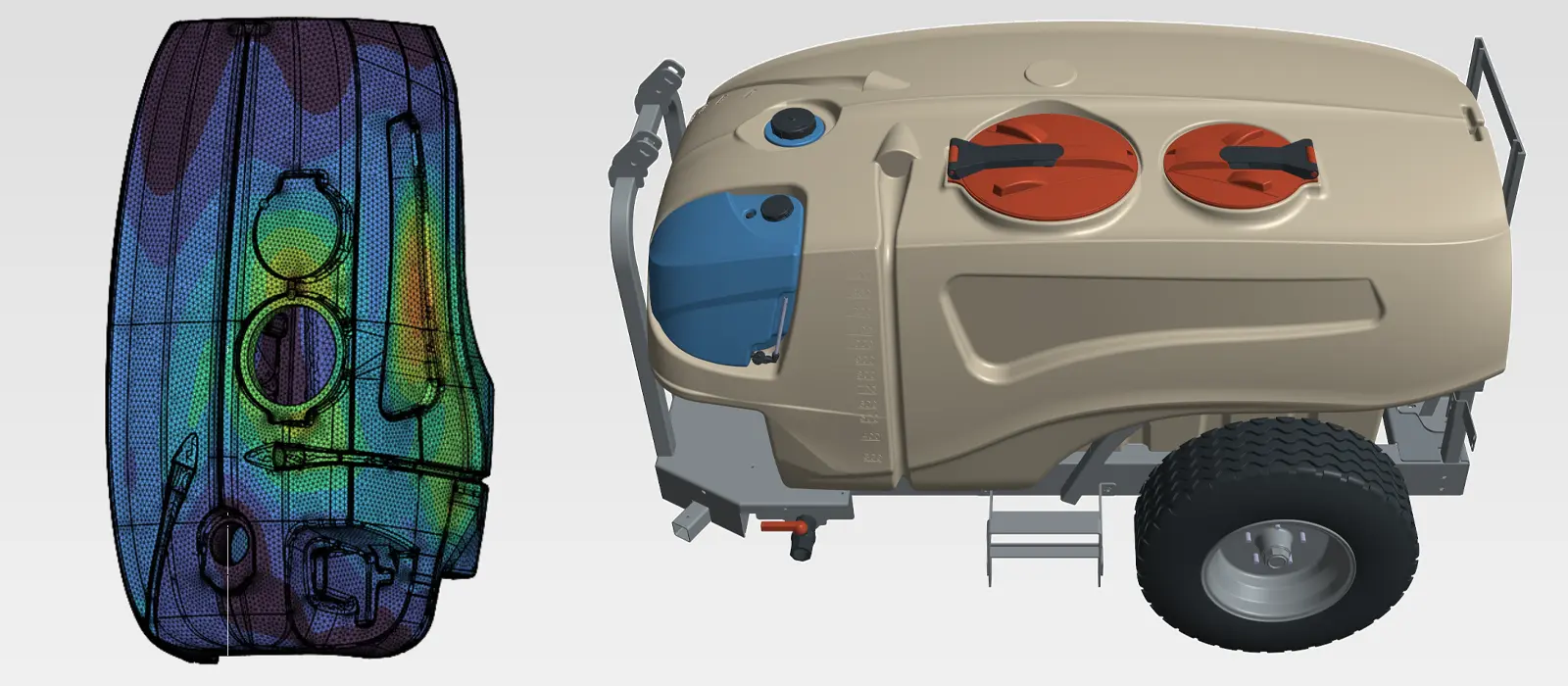
Finding a problem in one region does not mean that the wall thickness of the entire tank needs to be increased. In many cases, a more effective and economical solution can be achieved through the right geometry, proper support and correct load transfer.
- Body geometry and ribs:We improve rib placement, transitions and surface geometry in regions that flex excessively or where loads concentrate.
- Supports and chassis connection:We modify support geometry, bearing areas and connection layout so the tank sits on the chassis more effectively and the load spreads over a wider area.
- Wall thickness and material use:Instead of unnecessarily thickening the entire tank, we aim to achieve the strength the design actually requires at the lowest reasonable weight.
- Control of liquid motion:When necessary, we evaluate the location and geometry of internal guiding or partition elements that can reduce liquid movement inside the tank.
Scope & Deliverables
What Do We Evaluate in the Project?
- Tank geometry, wall thickness and critical regions
- Liquid density, fill levels and operating temperature
- Liquid pressure generated by filling
- Long-term deformation (creep) and temperature effects
- Loads caused by vehicle motion and field conditions
- Tank supports, chassis and connection conditions
- Liquid sloshing and CFD analysis when required
- Rotational moldability of the proposed modifications
Delivered Results
- Deflection, stress and contact-pressure color maps
- Close-up engineering visuals of critical regions
- Results comparing different operating conditions
- CFD pressure and force results when required
- Revision recommendations for wall thickness, ribs, supports and connection areas
- Chassis or metal support recommendations when required
- Revision notes marked on the CAD model and a short executive summary
New product design or validation of an existing product
The work can be used to identify problems in an existing agricultural tank and improve the design, or it can be applied before production by carrying out design and analysis together for a new product.